10.19.2005

An oldie but a goodie
Ever since I saw him on Charlie Rose a couple years ago, I've been terribly impressed with one Lt. General David Patraeus. I stumbled on this post from Tigerhawk a while back, and it addresses many of the worries folks like me have had about how things have proceeded in Iraq. I was reminded of it when reading about the recent voting for Iraq's constitutional referendum. This by no means provides excuse for those who have led poorly, but it does give me hope that there are some terribly competent folks out there doing their damndest to help this process to work and who are showing progress. What follows is copied directly from Tigerhawk's post and is long, but is quite engaging. If you'd prefer not to read it, here's the video (note, I got the realplayer link to work, but didn't have luck with the window's media player file).
In General Petraeus' conception, the Transition Command has five missions:
To "help Iraqis." "We believed what TE Lawrence said: “Do not try to do too much with your own hands. Better the Arabs do it tolerably than that you do it perfectly. It is their war, and you are to help them, not win it for them.”
To "organize" the Iraqi military. The task of building a functioning military and special police force is extremely complex, and the Iraqis are doing it with Coalition and NATO guidance. Iraq is doing its own "recruiting and vetting." We are helping them design the units, which includes the personnel and command structure of each unit from the platoon on up.
The organization of the training of the special Iraqi police had to be particularly original. We have "dramatically shifted" the police training from the Kosovo model. “Iraq is not a 9mm pistol world, it is an AK47 world.”
To equip the Iraqi military.
This is an enormous task. "I cannot overstate how big this mission is." More than 700,000 uniforms, 210,000 sets of body armor, hundreds of thousands of small arms, helmets, hundreds of million of rounds of ammunition, 20,000 vehicles and so forth have been distributed to Iraqi forces.
All these soldiers and equipment have been housed. We have built more than twenty facilities for the Iraqi military, including five large bases that can house an entire division, "each the size of Ft. Drum."
To train the Iraqi military.
Notwithstanding the huge size of Saddam's military, even experienced Iraqi officers did not know how to train. For example, they did not train with live ammunition because of shortages, and expressed wonder at American methods for teaching marksmanship. Historically, “the inshallah school of shooting” prevailed. Iraqi soldiers in combat would hold the weapon over their head, shoot wildly until the magazine was empty, and “inshallah -- meaning if God wills it -- you will hit something.”
To mentor Iraqi military and police leaders.
There are 115 Iraqi battalions in combat right now, and every single one of them has a ten man American training team. The American training team teaches the Iraqi officers how to lead and helps coordinate Coalition assistance in logistical matters and combat support. “A huge effort paying enormous dividends.”
So, what's the "bottom line up front?" Iraqi soldiers and special police are “very much in the fight,” as evidenced, “sadly,” by the casualties they have taken in combat, which are at least twice the American.
The most impressive thing about the Iraqi units is how tenacious they have become, notwithstanding early reports that they would cut and run. According to General Patraeus, since the January elections, from which the Iraqi security forces “took an enormous lift that still persists,” the Iraqi forces "have not run from a fight, they have not backed down." This strikes me, by the way, as enormously hopeful for the future of Iraq, the persistence of the counterinsurgency, and the power of democracy to motivate the fight against the war on terror.
More highlights from the Transition Command's work:
Under NATO's auspices, the Iraqi military academy is open with entirely Iraqi instructors. It might have been opened much earlier with foreign instructors, but the Coalition felt that it was important to make it an Iraqi endeavor. General Patraeus noted later that he was very unhappy that this achievement got essentially no coverage in the media given its importance to success in Iraq.
Short- Mid- and Long-Range plans for the future development of the military are in place and being executed, relating to force structure, training, institutions, equipment. This all being done in conjunction with Iraqis.
At any given time, there are more than 3000 Iraqis out of the country training, including 2000 at a police academy in Jordan, and another 200 at an elite training facility “in a neighboring country.” It was obvious that this neighboring country is classified, and we can assume that it isn't Jordan, which he mentioned specifically. Assuming that it isn't Syria or Iran, that leaves Kuwait, Saudi Arabia and Turkey. Since there would be no need to keep a facility in Kuwait secret and since it would be in Turkey's external interest to be seen to be helping NATO (given its pending application to join the EU), my guess is that the secret training facility is in Saudi Arabia, which undoubtedly does not want to be caught collaborating with the United States to kill Sunni guerrillas.
General Patraeus' discussion of metrics was very interesting, but I was only able to capture some of it. He did, however, explain the "readiness levels" that have so bedeviled the discussion of Iraqi preparedness.
There are 105,000 “trained and equipped” Iraqi forces through basic training and in the field under the Ministry of Interior Forces, which covers police, police commandos, highway patrol, dignitary protection, etc. These units are not “fully independent,” but they are getting there.
Ministry of Defense Forces Trained and Equipped 89,000, including the Iraqi Army, Special Operations, Air Force, Navy, and Combat Support.
“These are not people who have just walked across the stage. They are out there and in combat. For example, this number is about 12,000 fewer than the number of police trained, because some of them don’t make it.”
Soldiers are graduating every day. By the October 15 referendum on the constitution (which Patraeus predicted will pass), trained and equipped military and special police will total 200,000, and 300,000 by next summer.
The progress since the summer of 2004, when General Patraeus assumed command, has been considerable. Fifteen months ago, only six battalions of Iraqi army (less than 2,000 men) were in training, and none were "in the fight." Now, 14 battalions are in training, and 74 are operational and in the fight.
A year ago, there were no special police units. Now there are 27 battalions in the fight, and five more serving as border patrol and emergency response. These are all top-down units, none that have failed “like the homegrown Fallujah brigade.”
These units are all classified according to "readiness reports" that are very similar to those used for the American army.
Level 1 is fully independent, “capable of planning and executing operations, and sustaining itself, without coalition support.” This is a very high standard, and because it requires no coalition support in combat, whether logistical or in the form of indirect fire support. As reported this week, only one battalion operates at this level now, but the press accounts did not make clear what a difficult standard this is. Indeed, two other battalions had reached this level but were downgraded because of personnel changes (my sense was that a key officer was transferred).
A significant and growing number of Iraqi units are at Level 2, which is substantially, but not totally, independant. Level 2 units are “in the lead,”, "capable of planning, executing and sustaining counterinsurgency operations with some coalition support." These units are substantially independent, but still need some assistance with logistics and indirect fire support. However, they operate independently for most intents and purposes. Level 2 battalions now “own Haifa Street” in a way that only local units can, and another unit -- the armored battalion -- is policing the airport road. Level 2 units also run Karbala and Najaf security.
Level 3, “fighting alongside”: "capable of conducting counterinsurgency operations in conjunction with coalition units." The goal is to get most of these Level 3 units up to Level 2 in the next few months.
So, over 115 Army and special police battalions are in the fight, the majority of which are “fighting alongside.”
The training of the special police is also proceeding well. Iraqi cops are learning basic criminal investigation, internal controls, interviews and interrogations, elections security, counter terrorism, SWAT, dignitary protection.
“Not FBI caliber, don’t let me mislead you, but it is still very useful.”
The general took a number of questions from the audience, three of which were interesting.
The first dealt with the controversial disbanding of the Iraqi army. "What lesson could we learn from the disbanding of the Iraqi army?" Patraeus substantially dodged this question as not having been his call, but left the audience with two impressions. First, that the existing Iraqi army was not very useful: “I do not necessarily accept the idea that we should not have disbanded that Iraqi army. It was bloated with general officers – there were 1100 generals in one province alone, each one of whom expected us to do what they wanted – and it was an army that had not fought.” Second, without saying as much it is fairly clear from his comments that he thinks that we blew the means by which we disbanded the army, particularly in not having a plan to employ its soldiers and officers afterward.
The other interesting question involved the "public relations" war. "Are we losing the PR war to the enemy? What are you doing on the marketing PR front?"
General Patraeus said that they have given the media an enormous amount of information, including countless important metrics for measuring progress, but that it is largely ignored. He observed that the enemy “On many days it is impossible to break through the steady drumbeat of sensational attacks occurring in Baghdad throughout the country. The opening of the new military academy got no coverage at all, even though it was a big event with the whole Iraqi government in attendance."
Patraeus is obviously extremely unhappy with the monomaniacal press coverage.
Finally, Anne-Marie Slaughter asked the Abu Ghraib question – “what can we do, going forward, to acknowledge what we have to acknowledge but also to restore the values that we stand for in others eyes?”
Patraeus said that Abu Ghraib had been very damaging, but that there has been “an enormous change in the detainee operations piece... One of the lessons is that the most important job of a commander or leader is the setting of a tone. That sounds very simplistic, but in combat setting the right tone is hugely important.” I think we have gone back and looked very, very hard the tone we are setting. We have 29 operations lawyers [Good God. - ed.]. Patraeus described a recent "very minor" incident, and "we brought in the lawyers, brought in the imams," to discuss it openly and resolve it. And we are doing things that seem unimportant to us, but which are very meaningful to Iraqis. One of the imams asked us to install clocks in the prison so that the prisoners would know when to pray, so we put in clocks.
“How do we portray our sincere desire to help? It is very challenging, because the other side is enormously skilled in information operations. In Fallujah, by the way, there were two broadcasting stations in addition to the car bomb factories and the arms caches. The enemy is very sophisticated."
10.14.2005
Green pepper mango
Just before dinner this evening I mentioned a phenomena in the Midwest that I've found pretty entertaining. With the exception of my brother, no one at the table had really heard of it, but for us it was only second hand. Karla has told us that on many occasions when she was in high school and working at Subway she heard the word mango or mangoes for what she would consider, a green pepper. As in, "don't put any mangos on it", or "gimme more mangoes." My dad once told me about some neighbors we had who ate Vidalia onions like apples, and I think they also called 'em mangos. Well, I decided I had to do a little research and found this cultural definition or some such from the Dictionary of American Regional English, Harvard University Press, which seems excellent.
2 also mango pepper; pronc-sp mangle: A pepper, esp a green pepper 1. chiefly W Midl See Map1948 WELS Suppl. VA, I was surprised while living in Virginia to see green peppers advertised and sold as " mangoes. 1950 WELS (Large sweet peppers) 2 Infs, WI, Mangoes. c1960 Wilson Coll. csKY, Mango. . . Sweet pepper, bell-pepper. 1964 Gourmet May 2, [Letter:] The use of the term mango for bell pepper . . is not limited to Indiana. I have heard it used in Louisiana and Georgia. We once had an old English gardener up in Vermont many years ago, and he always called the green pepper a mango. Bird and chili peppers are also referred to as mangoes. 1965- 70 DARE (Qu. I22d, . . Peppers—large sweet) 113 Infs, chiefly W Midl, esp sIL, sIN, sOH, Mangoes; IN41, 48, Sweet mangoes; MO39, Mango peppers; MO5, MO27, Mangles; MO4, Tomato peppers—also called the little mangle peppers; (Qu. I22c, . . Peppers—small sweet) 15 Infs, chiefly N Midl, Mangoes; IL85, Small mangoes; OK3, Mango peppers; (Qu. I22b, . . Peppers—large hot) Infs IN76, KS1, PA150, Mangoes; MO6, Mangoes—not so hot nor so small; KS6, KY52, VA28, Mango peppers; IN41, 48, Hot mangoes; (Qu. I22a, . . Peppers—small hot) Infs IL7, MO18, Mango peppers; NJ2, Mangoes. 1970 DARE File KY, sOH, Mango—bell pepper. 1972 NYT Article Letters cnIN, In my home area, green (bell) peppers are called mangos.Then I found this article from the well named, "Food Resource Website". It's considerably more readable.
GREEN PEPPERS AND MANGOS
The word ‘mango’ is used in some areas to refer to green peppers or stuffed green peppers. Pennsylvania, West Virginia, Ohio, Indiana, Illinois and Missouri are all states that I have received e-mails about grandparents, parents and even current usage of ‘mango’ for green pepper.
Recent information I have come across (thanks in part to an e-mail from website visitor Richard Clark) I believe explains how and why the usage of the word spread along the path it did. Usage of 'mango' for green peppers seems to have originated with coal miners in eastern Pennsylvania (1870s +) - and spread with the mining industries, and then with the miners families as they migrated to new areas and found new jobs.
But why the word 'mango' for green peppers? Many of these coal miners were of Eastern European origin, and it has been suggested that the word may have a Slovak origin.
The English 'dialect' of the Appalachian region with its unique pronunciation, grammar, and word usage is due in large part to the immigration of miners, engineers and others from so many countries coming together in one area and being relatively isolated in the small mining towns.
They came from Russia, Poland, Czechoslovakia, Hungary, Germany, Scotland, Wales, Greece, Turkey, and Syria to name a few - so the word 'mango' might have been adapted from one of these languages.
Also, in many old cookbooks, 'mango' would sometimes be used to refer to a pickle, especially of melons or cucumber (resembling pickled green mango?)
'Mango' was also a term sometimes used to refer to cantaloupe in many old cookbooks).
So the question is, are there words in any Eastern European languages for melon and/or green peppers that may sound like ‘mango’?
Chef James
In the 1887 Edition of 'The Original White House Cook Book', there is a
recipe for Green Pepper Mangoes.
As follows:
“Select firm, sound, green peppers, and add a few red ones,as they are ornamental and look well upon the table. With a sharp knife remove the top, take out the seed, soak over night in salt water, then fill with chopped cabbage and green tomatoes, seasoned with salt, mustard seed and ground cloves. Sew on the top. Boil vinegar sufficient to cover them, with a cup of brown sugar, and pour over the mangoes. Do this three mornings, then seal.” That is the only recipe I have seen. J.M.
This would fit in with the use of ‘mango’ to refer to a pickle (mentioned above) and also brings in the use of Green Peppers.
Anyone with additional information about ‘mango’ green peppers, please E-mail me: ChefJames@FoodReference.com
I will add any new information here as I receive it. Chef James
8/2/2005
My cousin sent me (the Mango article) and I thought I would respond to the question about "mango" in Slavic languages. Our family originally is from northeastern Pennsylvania and my grandmother used "mango" for "green pepper." We've never been sure why. I can say that at least in Polish, Czech, Slovak and Serbo-Croatian, the word for pepper is some variation on "paprika." Slavic languages have tended to adopt the word "mango," for the mango fruit since historically it has been a non-native, uncommon fruit. In other words, the search for the origin of the use of "mango" continues.
Maybe the hypothesis about chutney is more helpful here. Since mango chutney is a fairly common type of chutney, perhaps it got shortened to "mango" in reference to all things similarly pickled. In addition to people of Eastern European background, late 19th cent. Pennsylvania also had high numbers of immigrants from the British Isles, who may have been familiar with such chutneys. One might think that "chutney" would have been the more logical adoption, but if neither mango nor chutney had any inherent meaning for a speaker of another language, it's reasonable to think that such a mistake could occur. Just a guess. By the way, in case you're wondering, the word for "pickle" in Slavic languages is nothing like "mango" either.
Hope this helps,
Tammy
Verrückt als Fuchs
I remember reading an article about the recall election in Caulleefownya where Arnold’s advisors begged him to respond to constant attacks from Bustamante that were beginning to erode his poll numbers. He responded that “No one wanted to speak first at the Mr. Olympia competitions. Wait for the end, that’s all people will remember”. He had the self-discipline to hold out to the end and won the election – looks like the same thing is happening now. All five of his referendums now appear to be winning which would be the largest political rout of California Democrats in history.
Also, while I’m not the Bush fan I used to be, it is worth noting that his insanely low poll numbers may not be completely by accident. He’s also used the “rope-a-dope” strategy successfully in his last two elections. He knows democrats are unable to DELAY gratification.
10.12.2005
Interesting article
I just stumbled on this article in the NYTimes. It's about international food aid...a little confusing, but pretty interesting I thought.
10.05.2005
Not the party of Reagan
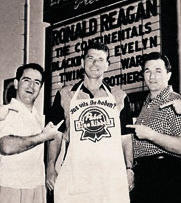
I grew up being serenaded by benefactors of the Johnson welfare state blaming Reagan for consigning them to starvation and ridiculous TV movies about being homeless and getting no help from the Government. Nothing says spending cuts like a ketchup sandwich. It was glorious. When Bush was elected I dreamed of long nights watching cable news laughing at the strained arguments Democrats would make for why the cut of a certain block grant or entitlement DOOMED!! their favorite victim group. Well we’re now in the 5th year and I haven’t once seen Bush called “heartless” 1/100th as much as Ronnie or even Newt Gingrich. Welfare reform under
The sad thing is that we can’t even wish we voted for the other guy (or party) because they’re even more pathetic. They’re just like that cloying guy that’ll say anything to get in a girls pants (See Stiffler in American Pie/American Wedding). For as good as Andrew Sullivan feels telling conservatives “I told you so” about Bush, at some level he must be relieved that Kerry wasn’t elected. He would have been an utter disaster.
Don’t agree? Watch.
Now I’m just looking forward to 2008. Hopefully we get a do over with McCain (or Condi).
UPDATE: Ugh. This is just nausiating.
10.02.2005
The inevitable outcome of government control?
 The safety issues raised in the following articles are interesting but probably insignificant. The odds of being in a plane crash in either a Boeing or Airbus plane are probably equal to being struck by lightning and being struck by lightning while holding a 3 iron aloft, respectively; both are very unlikely. However what the decision making behind these obvious lapses in design reveal is a recognition of the unusual environment in which Airbus exists. However much corporate welfare Boeing receives it’s still a private enterprise largely subject to the same market forces and liabilities as any other company while Airbus appears to be just another corporation, it's really just an extension of the governments of Spain, Britain, Germany, Austria, Belgium and France. This allows Airbus the luxury to pursue a volume business model (more jobs) and be less concerned by profits and quality. The effects of this strategy have been 2 fold: Airbus has supplanted Boeing as the unit sales leader and troubling patterns of safety system failure are beginning to appear. Most troubling is that the Airlines least likely to afford a top notch service crew seem to have the largest Airbus fleets. USAir/AmericaWest are the recent recipients of Airbus aircraft that were practically given away. Those who support initiatives to move to a government controlled healthcare system and support continued monopoly over K-12 education should keep an eye on Airbus in the years to come. However well meaning, government rarely achieves an adequate representation of society’s interests.
Here’s an article about an Airbus whistle-blower who’s actively being persecuted by the Austrian government for revealing a flaw in the new A380 that could cause a catastrophic loss in cabin pressure:
A year ago, Mangan told European aviation authorities that he believed there were problems with a computer chip on the Airbus A380, the biggest and costliest commercial airliner ever built. The A380 is a double-decked engineering marvel that will carry as many as 800 passengers — double the capacity of Boeing Co.'s 747. It is expected to enter airline service next year.Mangan alleges that flaws in a microprocessor could cause the valves that maintain cabin pressure on the A380 to accidentally open during flight, allowing air to leak out so rapidly that everyone aboard could lose consciousness within seconds.
Most passenger jets have two cabin-pressure valves, with separate motors operating each. Because aircraft makers want redundancy on safety systems, the planes have three motors for each valve, with different chips controlling each motor. The Boeing 777, for example, has cabin-pressure chips made by Motorola Inc., Intel Corp. and Advanced Micro Devices Inc. Most jetliners also have a manual override so that the pilot can take control in an emergency. Airbus has acknowledged that its designers faced challenges as they attempted to reduce the A380's weight. Early on, the company elected to go with four outflow valves on the A380, with only one motor on each valve, which is slightly larger than a cabin window. Each motor uses a TTTech controller chip, and there is no manual override system."Just there, I would not be happy," said Chris Lomax, a retired engineer who helped design the cabin-pressurization systems for Boeing's 737 and 747. "If all four valves [on the A380] were driven wide open, it would be nip and tuck for the crew to get their [oxygen] mask on and begin a descent."
Here’s another article detailing 67 incidents simply involving the nose landing gear of Airbus Aircraft since 1989:
The problems with JetBlue Flight 292 marked at least the seventh time that the front landing gear of an Airbus jet has locked at a 90-degree angle, forcing pilots to land commercial airliners under emergency conditions, according to federal records.
The locking of the nose landing gear on Airbus jets is one of several recurring problems with the plane's nose landing gear.A Canadian study issued last year documented 67 incidents of nose-landing-gear failures on Airbus 319, 320 and 321 aircraft worldwide since 1989.
9.28.2005
Another Reason Liberals Should Ditch Unions
Every time a conservative resists increasing funding on some additional social program (God help them if they’d actually cut), Democrats reliably trot out the underclass and play their ace card; “What about the children?” Whatever currency this bit of rhetorical manipulation has left will quickly disappear as stories like this percolate out of New Orleans.
Here’s an amazing article (also courtesy of Mickey Kaus) detailing how unions (and their liberal politician allies) are making the children of inner cities poor and stupid.
ROBERT THOMPSON wanted to give away $200 million to help children escape some of America's worst public schools. But for three years the successful businessman turned education philanthropist suffered the wrath of Michigan's Democratic establishment for his politically incorrect charter-school proposal. Then finally in August, Thompson found an ally willing to accept his charity. The nonprofit Skillman Foundation will join him in creating the first of 15 planned charter high schools in Detroit. The schools' goal is a "90/90 system"--that is, a graduation rate of 90 percent (up from the city's current 50 percent) and a college admission rate of 90 percent.
Officials reacted to Thompson's proffered $200 million not with gratitude but with rage. The Michigan Federation of Teachers urged a walkout, declaring a school holiday so that union members could march on the state capitol in protest of charter schools. State Democrats cowered before the union, while Detroit's politicians bristled at a white suburbanite's "meddling" in the city's affairs. Detroit mayor Kwame Kilpatrick--whose own children attended a charter school--responded to Thompson's offer by saying, with a dismissive wave of the hand, "Let us make the rules, and if he can't abide by the rules . . "
Says Thompson, "We thought if we tried to do good things, people would appreciate it. I guess we were naive." Shunned and saddened, Thompson withdrew his offer in October 2003.
Yet he persevered. "I thought, How can you change the world a little bit?" he says. "You can't let those kids down. You've got to figure out how to do this."
The breakthrough came in March 2005, when he received a call from another rich businessman with a passion for Detroit's poor: ex-Pistons basketball star Dave Bing.
Bing's color was a powerful political asset for Thompson, and together they approached the Skillman Foundation, a black-run nonprofit that has long worked with Detroit's public schools. Even so, Bing and Skillman came under immediate fire from Detroit liberals.
A group named the Call 'Em Out Coalition gave Bing a "Sambo Sell-Out Award" at its annual dinner for partnering with a white businessman. The award was bestowed by Democratic City Council member Sharon McPhail. And the Detroit Federation of Teachers expressed its displeasure with Skillman by threatening to end its cooperation with the foundation on other city school projects.
Here's hoping...
Drudge has his little siren up. Looks like Delay is going to be indicted and it says he may have to step down from his leadership position.
9.22.2005
Compelling rationale for why Liberals don't need Unions
Mikey Kaus from Slate has a terrific response to Matthew Yglesias's contention that [Kaus is paraphrasing here], "by attacking the Davis-Bacon Act, I'm guilty of pursuing good policy. Instead, "progressive" Democrats should be pursuing not-so-good policies that nurture powerful pro-Democratic interests."
The two most interesting reasons are:
5) "Historically," as Yglesias notes, unions have selflessly helped Democrats solve a number of national problems (Social Security, medical care for the elderly, civil rights, worker safety, unemployment insurance). Unfortunately, what's left are the national problems where this New Deal pairing didn't work because unions actively stand in the way of solutions. Two of these problems, in particular, are among our biggest: a) Unionized teachers stand in the way of the educational changes that might ameliorate our twin education crises (inner city disaster and suburban mediocrity). And b) unions stand in the way of the best solution to the welfare problem (and hence the NewOrleans-style underclass problem, and hence the persistent-poverty problem), namely public jobs programs. Unions have always disliked public jobs programs because public jobs workers threaten to perform work that municipal unions and construction unions now perform for far more money (thanks, in part, to the Davis-Bacon Act). In my ideal of liberal activism, we make sure everyone who wants a job has a job. Then we worry about making those jobs pay $40 an hour rather than $8 an hour. Unions have always (quite rationally) preferred to increase their members' wages even if that means keeping unemployed workers on the dole. That's why FDR had to break a strike to keep the WPA going. Yglesias argues Democrats won't "be able to advance a sustained anti-poverty agenda" with weakened unions. I'd argue that they won't be able to do that without rolling a few unions.
6) The best way to raise wages at the bottom, we've discovered, is not to increase union power. It's to run a hot economy with a tight labor market like the one we had in the late 90s--when unions continued to decline but low-wage workers and African-Americans made huge strides. (Low inflation helped achieve that prosperous economy and preserved those gains--unlike in the 70s, when still-powerful, oligopolistic unions were the mainspring of a wage-price spiral.) Yglesias says it's "absurd" to fight poverty without unions, but the most effective program to fight working poverty that we've discovered is the Earned Income Tax Credit, which has little to do with unionism and will survive unionism's inevitable withering. So will minimum wage laws.
9.18.2005
World travellers
Hello all, I've just added two new links under the Friends section. One is Garrett Bucks' blog, who is currently in Sweden on a Fulbright scholarship. The other is Ian Miller's, who is doing the Peace Corps in Vanuatu. Enjoy their antics with mind-enhacing roots and Swedish pop stars.
9.17.2005
Christmas comes early
Bonus Bonus!: NYTimes discovers that continuing the Howell Raines tradition of alienating half their national audience isn’t a good business plan.
The New York Times Co. said Tuesday it would cut about 500 jobs, or about 4 percent of its work force, as part of an ongoing effort to reduce costs. The reductions come atop another 200 jobs that were cut earlier this year.
Arthur O. Sulzberger, Jr. tries to explain the Times’ decline on the economy:
"We regret that we will see many of our colleagues leave the Company; it is a painful process for all of us. We have been tested many times in our 154-year history as we are being tested now.
Given the continued financial challenges and the cloudy economic outlook for the remainder of the year, we believe it is prudent and necessary to initiate this additional reduction. We will be working through the bargaining issues with our unions and will observe all contractual obligations, including severance where applicable. The Company plans to manage the staff reductions in such a way that we continue to provide our readers, users, listeners and viewers with journalism of the highest quality and that our operations function smoothly on a day-to-day basis. This will help ensure that we achieve our long-term strategic goals.”
But Gannett, owner of over 300 newspapers including USA Today, is doing just fine. Unless making money isn’t one of Sulzburger’s strategic goals he better wean his editors off of advocacy journalism real quick.
*Ask me about how the Sulzburger family stripped the New York Times Co. shareholders of all meaningful voting rights therefore removing the last barrier of oversight capabile of keeping the once great grey lady from slipping into liberal crapulence. Do it! Do it!
BONUS: The ombudsman for the Corporation for Public Broadcasting believes NPR programming is extremely biased and that the resulting alienation this has caused is producing an audience that is completely counter to the populist objectives of the CPB’s founding charter; wefare media for the wealthy.
"Like many metropolitan areas, Washington has multiple NPR and PBS outlets. One evening this summer, Boaz was listening to public radio when a commentary by liberal former Labor Secretary Robert Reich was aired. Boaz switched to another NPR station, only to hear the views of liberal commentator Daniel Schorr. "That's not just liberal bias," Boaz says, "it is a liberal roadblock."
PBS President and CEO Pat Mitchell assured the Senate subcommittee that "our viewers and our supporters reflect and mirror very closely the demographic make-up of our communities." Potential advertisers are told instead of a 2003 Mediamark poll commissioned by NPR. Compared to the general public, NPR listeners are 152 percent more likely to own a home valued at $500,000 or more; 194 percent more likely to travel to France; and 326 percent more likely to read the "New Yorker."
I really, really despise(d) Paul Krugman, but I know this already has been talked to death elsewhere so I’ll be brief. I’m just amazed that the ombudsman of the NYTimes has come out publicly stating that the left’s best known economist is a serial liar. Better still -- despite knowing of Krugman’s deceptions, the editorial staff of the paper has apparently decided not to enforce its own editorial policies.
An Op-Ed columnist for The New York Times who makes an error "is expected to promptly correct it in the column." That's the established policy of Gail Collins, editor of the editorial page. Her written policy encourages "a uniform approach, with the correction made at the bottom of the piece."
The following refers to a recent column in which he misrepresented findings of the media panel regarding the outcome of the 2000 election, and then lied about them again in his correction of the first column.
All Mr. Krugman has offered so far is a faux correction. Each Op-Ed columnist has a page in nytimes.com that includes his or her past columns and biographical information. Mr. Krugman has been allowed to post a note on his page that acknowledges his initial error, but doesn't explain that his initial correction of that error was also wrong. Since it hasn't been officially published, that posting doesn't cause the correction to be appended to any of the relevant columns.
If the problem is that Mr. Krugman doesn't want to give up precious space in his column for a correction, there are alternatives. Perhaps some space could be found elsewhere on the Op-Ed page so that readers—especially those using electronic versions of his pieces -- could get the accurate information they deserve.
A bottom-line question: Does a corrections policy not enforced damage The Times's credibility more than having no policy at all?
So now having been officially reviled by his own paper, I don’t think anyone can argue he has any meaningful credibility anymore. He’s done.
Now I can focus on Robert Reich…
9.15.2005
Hitch vs. Galloway
It's been podcast here for posterity. I haven't gotten the chance to listen to it yet, so I don't have a lot to say about it. However, I think Galloway is a contemptable turd on the order of Tom DeLay and I would looooovvvveee to see him verbally thrashed.
For the actual argument's sake I'd much prefer someone like Jon Stewart do battle with Hitchens (who has made some of the best reasoned cases for the war in Iraq that I've read), but this will do.
But I'm quite curious to hear what y'all think, so have at it...
9.14.2005
Speaks for itself
More foolishness from Mr. DeLay:
House Majority Leader Tom DeLay said yesterday that Republicans have done so well in cutting spending that he declared an "ongoing victory," and said there is simply no fat left to cut in the federal budget.Then there's this from his collegues:
Mr. DeLay was defending Republicans' choice to borrow money and add to this year's expected $331 billion deficit to pay for Hurricane Katrina relief. Some Republicans have said Congress should make cuts in other areas, but Mr. DeLay said that doesn't seem possible.
"My answer to those that want to offset the spending is sure, bring me the offsets, I'll be glad to do it. But nobody has been able to come up with any yet," the Texas Republican told reporters at his weekly briefing.
Asked if that meant the government was running at peak efficiency, Mr. DeLay said, "Yes, after 11 years of Republican majority we've pared it down pretty good."
"This is hardly a well-oiled machine," said Rep. Jeff Flake, Arizona Republican. "There's a lot of fat to trim. ... I wonder if we've been serving in the same Congress."I'm not putting this up there as a means to say, "Oh, look this is Republican, look how dumb and corrupt he is, that is a good example of how dumb and corrupt all Republicans are." I'm pointing at him because he, as an individual, is a contemptable liar who needs to be made fun of and put in his place (which should be as far away from the halls of congress and power as possible). Dean and Feinstein may be contemptable, but they're not quite as outragous (to me at least) as this piece of shit.
American Conservative Union Chairman David A. Keene said federal spending already was "spiraling out of control" before Katrina, and conservatives are "increasingly losing faith in the president and the Republican leadership in Congress."
"Excluding military and homeland security, American taxpayers have witnessed the largest spending increase under any preceding president and Congress since the Great Depression," he said.
Mr. Keene said annual nonmilitary and non-homeland security spending increased $303 billion between fiscal year 2001 and 2005; the acknowledged federal debt increased more than $2 trillion since fiscal year 2000; and the 2003 Medicare prescription drug bill is estimated to increase the government's unfunded obligations by $16 trillion.
Good Roberts Piece
Here’s some pretty good commentary on the state of the confirmation hearings from Dahlia Lithwick – who I typically disagree with. After listening to some of the hearings yesterday on my way home from work, I too came to the conclusion that the Senators would have been best served to allow some to assume they're stupid than open their mouths and prove it. Especially Joe Biden – who I think may actually be retarded.
John Roberts is putting on a clinic.
He completely understands that he needs only to sit very quietly, head cocked to signal listening-ness, while senator after senator offers long discursive rambling speeches. Only when he's perfectly certain that a question has been asked does he offer a reply; usually cogent and spare. Here's a man long accustomed to answering really hard questions from extremely smart people, suddenly faced with the almost-harder task of answering obvious questions from less-smart people. He finds himself standing in a batting cage with the pitching machine set way too slow.
It's increasingly clear that Senate Democrats are giving up. They are taking a cue from the petulant Joe Biden, who telegraphs exactly who these hearings are really for when he refuses to let the nominee answer any of his questions. When Sen. Arlen Specter growls at Biden to let Roberts finish just one answer, Biden growls back: "I don't have much time." Later when Biden complains of Roberts, "But he's filibustering!" it's without any sense of irony. How dare this man use our own childish games against us?
9.12.2005
LA Power Outage
The power is out in Los Angeles – and where the hell is George W. Bush?
Why hasn’t he said anything empathetic yet? It’s been hours!
Does he even care what the people of Los Angeles are going through? Not everyone in Hollywood can just get into a Range Rover and turn on the air conditioning. Some people only have Mercedes and BMWs and red Corvettes.
How long is the rescue effort going to take? Surely, Bush is not waiting on the mayor and the governor again. Big-foot them now! I’ll bet Bush is playing his silly banjo.
Hee Hee
Oh Tom you card.
Wow.
This morning, U.S. House Majority Leader Tom DeLay's visit to the Reliant Park this offered him a glimpse of what it's like to be living in shelter.
While on the tour of a shelter with top administration officials from Washington, including U.S. Secretary of Labor Elaine L. Chao and U.S. Treasury Secretary John W. Snow, DeLay stopped to chat with three young boys resting on cots.
The congressman likened their stay to being at camp and asked, ``Now tell me the truth boys, is this kind of fun?''
They nodded yes, but looked perplexed.
9.07.2005
Great arguments on the Daily Show
Christopher Hitchens, the contrarian, and Jon Stewart get into a reasonable, fun argument on Iraq. Here's the video. (Check it soon, it may be gone or hard to find after two weeks or so.)
I'm not sure who I think "wins" but the discussion is invigorating. I could watch them go at it for hours so wish this clip wasn't limited to 8 minutes. Enjoyable none-the-less.
9.06.2005
Hurricane Katrina relief
Here is a list of charities compiled by Glenn Reynolds of Instapundit for Hurricane Katrina relief. I apologize for the belated nature of this post, please give what you can.
9.04.2005
Where Oil Company Profits Go

I’ve been listening all week to scores of pundits including Bill O’Reilly argue for caps on Oil Industry profits stating that they are profiting “unfairly” and have become increasingly infuriated at how general economic ignorance on the part of journalists is adversely affecting the understanding of basic economic principles within the public. Oil Industry executives are not Ken Lay Monopoly men using profits to light cigars with $100’s. Like all commodities providers, when demand increases, profit increases, and this profit is invested to provide even greater supply to create more profits. It’s happened since the Roman Empire and is happening yet again.
Since 1981, Shell researchers at the company's division of "unconventional resources" have been spending their own money trying to figure out how to get usable energy out of oil shale. Judging by the presentation the Rocky Mountain News heard this week, they think they've got it.
Shell's method, which it calls "in situ conversion," is simplicity itself in concept but exquisitely ingenious in execution. Terry O'Connor, a vice president for external and regulatory affairs at Shell Exploration and Production, explained how it's done (and they have done it, in several test projects):
Drill shafts into the oil-bearing rock. Drop heaters down the shaft. Cook the rock until the hydrocarbons boil off, the lightest and most desirable first. Collect them.
Please note, you don't have to go looking for oil fields when you're brewing your own.
On one small test plot about 20 feet by 35 feet, on land Shell owns, they started heating the rock in early 2004. "Product" - about one-third natural gas, two-thirds light crude - began to appear in September 2004. They turned the heaters off about a month ago, after harvesting about 1,500 barrels of oil.
While we were trying to do the math, O'Connor told us the answers. Upwards of a million barrels an acre, a billion barrels a square mile. And the oil shale formation in the Green River Basin, most of which is in Colorado, covers more than a thousand square miles - the largest fossil fuel deposits in the world.
Wow.
They don't need subsidies; the process should be commercially feasible with world oil prices at $30 a barrel. The energy balance is favorable; under a conservative life-cycle analysis, it should yield 3.5 units of energy for every 1 unit used in production. The process recovers about 10 times as much oil as mining the rock and crushing and cooking it at the surface, and it's a more desirable grade. Reclamation is easier because the only thing that comes to the surface is the oil you want.
And we've hardly gotten to the really ingenious part yet. While the rock is cooking, at about 650 or 750 degrees Fahrenheit, how do you keep the hydrocarbons from contaminating ground water? Why, you build an ice wall around the whole thing. As O'Connor said, it's counterintuitive.
But ice is impermeable to water. So around the perimeter of the productive site, you drill lots more shafts, only 8 to 12 feet apart, put in piping, and pump refrigerants through it. The water in the ground around the shafts freezes, and eventually forms a 20- to 30-foot ice barrier around the site.
Next you take the water out of the ground inside the ice wall, turn up the heat, and then sit back and harvest the oil until it stops coming in useful quantities. When production drops, it falls off rather quickly.
That's an advantage over ordinary wells, which very gradually get less productive as they age.
Then you pump the water back in. (Well, not necessarily the same water, which has moved on to other uses.) It's hot down there so the water flashes into steam, picking up loose chemicals in the process. Collect the steam, strip the gunk out of it, repeat until the water comes out clean. Then you can turn off the heaters and the chillers and move on to the next plot (even saving one or two of the sides of the ice wall, if you want to be thrifty about it).
Most of the best territory for this astonishing process is on land under the control of the Bureau of Land Management. Shell has applied for a research and development lease on 160 acres of BLM land, which could be approved by February. That project would be on a large enough scale so design of a commercial facility could begin.
The 2005 energy bill altered some provisions of the 1920 Minerals Leasing Act that were a deterrent to large-scale development, and also laid out a 30-month timetable for establishing federal regulations governing commercial leasing.
Shell has been deliberately low-key about their R&D, wanting to avoid the hype, and the disappointment, that surrounded the last oil-shale boom. But O'Connor said the results have been sufficiently encouraging they are gradually getting more open. Starting next week, they will be holding public hearings in northwest Colorado.
Subscribe to:
Posts (Atom)